A first look at convex analysis
Introduction to convex sets, functions, and basic properties
Despite the fact that many problems encountered in statistics and machine learning are not convex, convexity is an important to study in order to understand what is the generic behaviour of an optimization procedure.
1 Convex set
A set
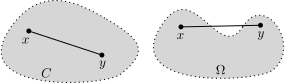
Definition 1
A set
In most of these lecture notes, the set
Example 2
-
The convex sets of
are exactly the intervals of . -
Any affine hyperplane
where is a real vector space, a linear functional and is convex. -
Any half-space
is also convex. -
The unit simplex of
defined as
is convex.
- The nonnegative orthant
is convex.
The following proposition reviews some important algebraic properties of convex sets.
Proposition 3
-
Arbitrary intersection. Let
convex sets where is a set. Then is convex. -
Cartesian product. Let
be sets of . Then is convex if, and only if, every is convex. -
Sum. Let
, two convex sets. Then the (Minkowski) sum is convex. -
Affine map. Let
be an affine map and a convex set. Then the image is convex.
2 Convex functions
The intuitive definition of a convex function is a function such that “the line joining
Definition 4
Let
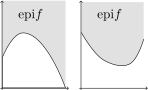
Equipped with this notion, we can define convex functions using the definition of convex sets applied to the epigraph.
Definition 5
A function
It is possible to make explicit this definition as follow:
Following the convention introduced in (Hiriart-Urruty, Jean-Baptiste and Lemarechal, Claude, 1996), we will denote the set of all convex functions of
2.1 Local and global minima of a convex function
For a (un)constrained minimization problem on a convex set
we say that
-
a local solution of (2), if there exists a neighborhood
of such that for all , ; -
a (global) solution if for all
, .
A fundamental result is that, when
Theorem 6
Assume that
Proof
Part 1. By contradiction.
Consider a local solution
Given any open neighborhood
Part 2. Take two global solutions, and study the segment joining it: let
where the first inequality comes from the equality of the function at
2.2 Differentiable properties of a convex function
A differentiable function is convex if, and only if, it is above all its tangents, see Figure 4.
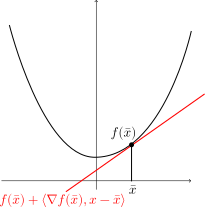
Proposition 7
Let
Proof
Assume
Dividing by
Reciprocally, let
Using a convex combination of these two lines, we get
which is exactly (1).
A similar criterion can be derived for strictly convex function.
Remark that Theorem 6 is a direct consequence of Proposition prop-convex-diff for the class of differentiable convex functions: a local minima
3 Strongly convex functions
A strongly convex function satisfies a stronger statement of the Jensen’s inequality.
Definition 8
A function
for all
Another way to define strongly convex function is to say that
is a convex function.
A strongly convex function defined on the whole space
3.1 Differentiability, strong convexity and quadratic lower bound
A function
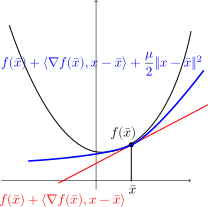
Proposition 9
Let
Note that if
An easy consequence is that it is possible to establish a lower bound on the values based on a lower bound on the distance between points:
where
4 Lipschitz continuity of the gradient
Definition 10
A differentiable function
Here
4.1 Quadratic upper bound
Proposition 11
Let
Moreover, if
Proof
The fact that
Given
Now,
Reciprocally, if (5) holds, it is sufficient to apply it twice (to
This result has a strong implication on the minima of
Proposition 12
Let
Proof
The two side are proved separately.
rhs: Apply (5) applied to
lhs: Minimize the quadratic upper bound for
where the last inequality is obtained by the change of variable
Hence,
Minimizing the infimum boils down to maximizing
4.2 Co-coercivity of the gradient of a
Convex
Proposition 13
Let
Proof
Let
Since
Canceling the gradient of
Doing exactly the same thing for
It turns out that smoothness, co-coercivity and upper quadratic boundness are equivalent properties for full-domain convex function.
Proposition 14
Let
-
is -smooth. -
The quadratic upper bound (6) holds.
-
is -co-coercive.
Proof
The only one to prove is 2.
For the special case of the
Proposition 15
Let
is monotone, i.e.
-
is convex. -
If
is twice differentiable, then,
When
Proposition 16
Let
Proof
Consider the convex function
Hence,
If
Explicing the expression of
Baillon, Jean-Bernard and Haddad, Georges (1977). Quelques propriétés des opérateurs angle-bornés etn-cycliquement monotones.
Hiriart-Urruty, Jean-Baptiste and Lemarechal, Claude (1996). Convex Analysis and Minimization Algorithms I: Fundamentals, Springer.